Part 1
Runaway to Join the Ships: A Lascar Agreement
Growing up I heard numerous heartwarming
stories about my grandfather, he was seaman, a ship jumper, an alien, labeled
as a "Non-Resident Indian. He would live under the radar of immigration
laws, agents, and his constant fear of deportation. He sought to become a part
of the "New American" immigrant identity despite his challenges his
attempts to acquire citizenship, he married twice, had a son, assisted in
raising stepchildren, became a businessman, and helper to establish the Muslim Bengalis
community, like the India League of America in Harlem during 20s, 30s, 40s and 50s.
A witness to the many historical events in New York City, like the arrest of 7
Hindus in the steel mills in Western Pennsylvania.
Grandfather was instrumental in
establishing one of the early mosques in New York City, now one of the largest
on the Upper East side today. Part of seamen ex-pats who occupied his own
immigrant neighborhood at laundry shops, Ceylon Indian Restaurant,
boardinghouses, employment maritime agents, tenement homes in Harlem, on the
Lower East Side and steel mills in upstate New York. In addition, his
participation in the process of the Luce-Celler Act of 1946.
My focus is
the biography of my grandfather, Abdul Goni. He journeys and experiences as a
merchant seaman. Why did he jumped ship, become an alien and later an immigrant
in the United States from 1920s to 1950s? How did the British Empire and the
United States influence his life decisions? And finally, to understand the
roles he took on in shaping his national identity.
 |
| Map of India, 1903. Outline is the city of Calcutta, it spills into the Bay of Bengal. |
 |
| Map of Calcutta. Bird's eye view of the city center adjacent to the Hooligy River, which spills out to the sea. 1893. |
Abdul Goni or Ibrahim Abdul Goni was
born July 15, 1898, or 1900 in Calcutta of the tribe of the Bengali, more
likely his first name was Ibrahim and not Abdul Goni. For this blog I will refer to
him as Abdul Goni or Grandfather.
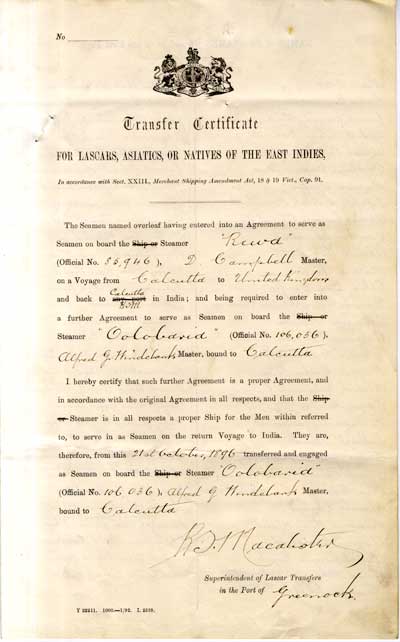 |
| Lascar Transfer Agreement between the masters of the Rewa and the Oolobaria. Forcing lascars back to British India did not require permission from the lascar crew. |
What is a "lascar agreements"
The British East India Company
recruited seamen or lascar, as Bengali Muslims were often referred to as
derogatory term, from areas around its factories in Bengal, Assam, Gujarat, and
outskirts of Calcutta villages.
Lascars would serve on British Merchant Navy ships under "Lascar Agreements", giving captains more control. The sailors could be transferred from one ship to another and retained in service for up to three years at one time. Captains would withhold payments, which grandfather would receive his payment consisting of 1/3 or 1/5 of what the white seamen would receive.
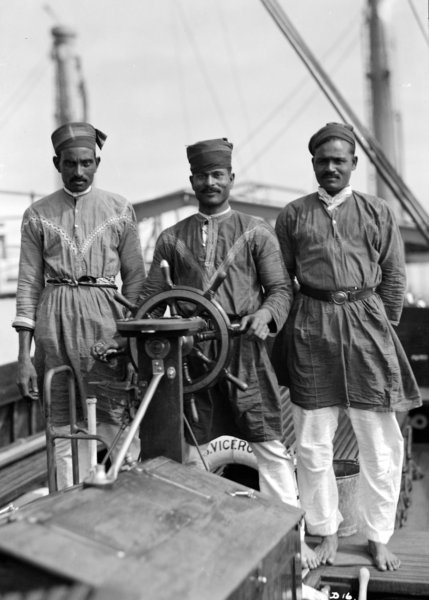 |
| Three lascars crew of the P & O liner RMS Viceroy of India. 1930-1939. https://en.wikipedia.org/wiki/Lascar#/media/File:Three_Lascars_on_the_Viceroy_of_India.jpg |
My uncles and other relatives often informed me grandfather was a longshoreman working in the bottom of the vessel with the heat and fire. In Jesse Ransley’s Blacks and Asian Seamen of the Forgotten Wrecks of the First World intensely describes, “Muslim Asian seamen worked in the engines room or ‘stokeholds’ (greasing machinery), trimmers (moving coal around to keep the ship balanced) and donkeymen (tending the auxiliary boilers).” What vivid description, I am imagining grandfather slaving in herculean conditions, coupled with fewer rations, inadequate berths, ever threats of injury, illness, or worst death. Along with draconian policies, British ships in port, maintain strict orders of seamen to stay on ships in part due to racist attitudes and immigration fears about hygiene, disease, and cultural differences.
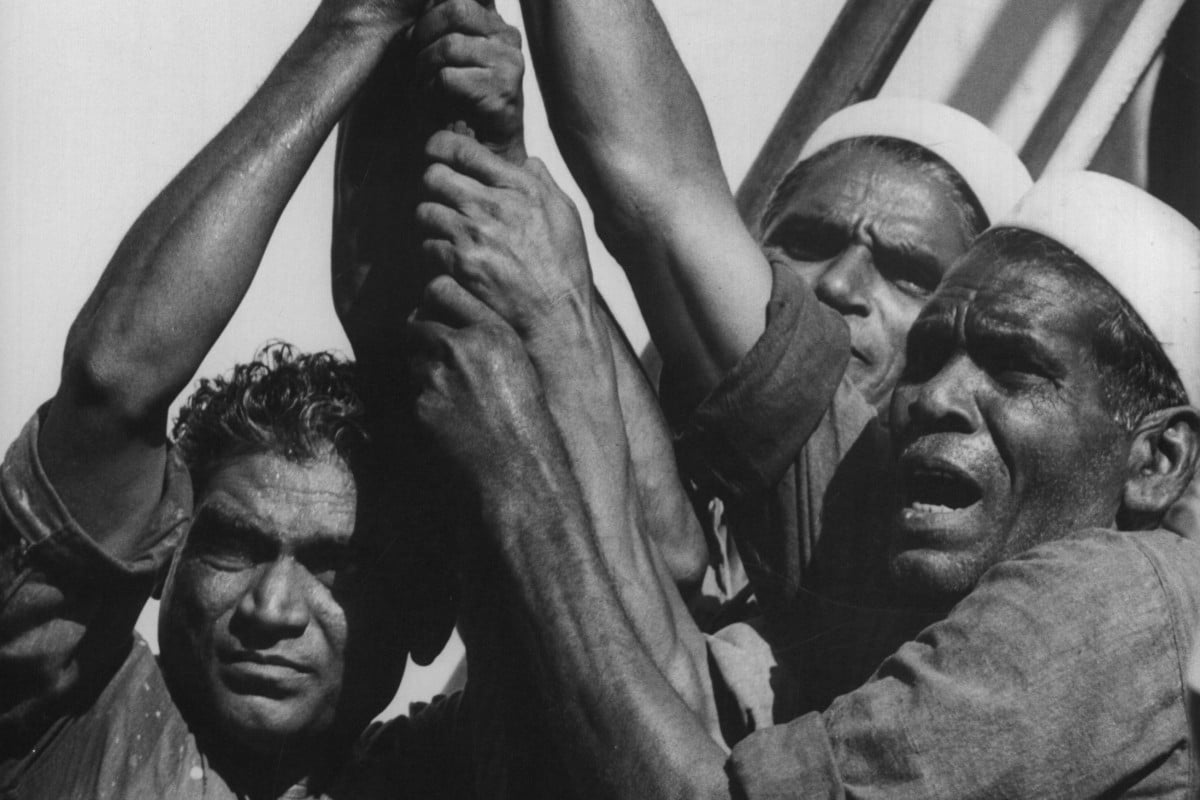 |
| Lascar crew members aboard P&O liner the Kampala. Photo: Getty Images |
Recently, thirty- nine Indian workers
of the Bethlehem Steel Company were arrested without warrants at the gates of
the factories in Bethlehem, Pa. . . . were taken to Ellis Island. . . . At this
gate of America, they were lodged in filthy cells full of vermin. . . . The British Captain of the Lucerus appeared
on the scene and the Hindusthanees were summarily ordered to follow him to the boat,
and there [return to] work as seamen. But when they came to know it was a
British ship . . . they flatly refused to obey the order. Asked the reason,
they said that to work on board a British ship was worse than working in
“hell.”
-Basanta Kumar Roy, The Independent Hindusthan, October 1920
Next post I write
how my grandfather, Abdul Goni became a ship jumper.
Citations
Bald, V. (2013). Desertion and Sedition: Indian Seamen,
Onshore Labor, and Expatriate Radicalism in New York and Detroit, 1914–1930. In
The Sun Never Sets (pp. 75-). NYU Press.
Ransley, J. (n.d.). Blacks and Asian Seamen of the Forgotten Wrecks of the First World War. The Maritime Archaeology Trust, National Oceanography Centre, Southampton. SO 143ZH2022, 1–44. Maritime Archaeology Trust.org
Roy, B. (1930). Doing England’s Dirty Work. The Independent Hindustan, 1(2). https://www.saada.org/item/20120111-575
Map of Calcutta from Constable's 1893
https://mha.mun.ca/mha/mlc/seafarers/lascars/remainder-of-crew.php


No comments:
Post a Comment